


The California Department of Alcoholic Beverage Control processed more than 9,700 new license applications in a single recent fiscal year, according to its own workload summary. That’s a lot of businesses competing for a limited pool of licenses, and that scarcity is exactly why getting a liquor license here feels so much more complicated than it should.
Most guides online just repeat the official ABC steps and stop there. This one goes further: the quota system that makes licenses scarce in the first place, when buying an existing license beats waiting for a new one, what a conditional use permit actually requires, and what happens if your application gets denied. Here’s what we’ll cover:
Which license type fits your business, and why that decision matters early
The quota system and why some counties have almost no licenses left
The full application process, step by step
RBS certification, CUPs, and real total costs beyond the application fee
What to do if you’re protested, denied, or need to operate while you wait
Alcohol License California: Which Type Do You Actually Need?
The type of alcohol license California requires for your business depends entirely on how you plan to sell alcohol, not just what you plan to sell. Get this decision wrong early, and you can end up refiling an entire application months later.
On-Sale vs Off-Sale: What’s the Difference?
An on-sale license covers alcohol meant to be consumed where it’s sold, the kind a restaurant or bar needs. An off-sale license covers sealed containers a customer takes home, the kind a liquor store or grocery store needs. Some licenses, like the Type 47, actually include a limited version of both.
Type 47, Type 41, Type 48, Type 20, Type 21: A Quick Reference
Type 47 (on-sale general, eating place): Beer, wine, and distilled spirits for restaurants that meet the food service requirement
Type 41 (on-sale beer and wine, eating place): Beer and wine only, same food service requirement, typically faster to obtain
Type 48 (on-sale general, public premises): Full liquor for bars and nightclubs, no food requirement, but harder to get in dense areas
Type 20 (off-sale beer and wine): Grocery and convenience stores selling beer and wine to go
Type 21 (off-sale general): Liquor stores selling beer, wine, and spirits to go
Why Are Liquor Licenses So Hard to Get in California?
The state caps how many “general” licenses, meaning Types 47, 48, and 21, can exist in one county. Once a county hits its cap, no new licenses open up until the population grows or an existing licensee gives one up.
How Does the County Quota System Work?
Each county gets a population-based allotment of general licenses. When a slot opens, the ABC issues it through a priority drawing, a lottery among that year’s applicants. In dense counties like Los Angeles, San Francisco, or San Diego, that quota is often already maxed out, which means a new license drawing might not happen at all in a given year.
How long does it take to get a liquor license in California?
A standard new application typically takes 90 to 120 days if there are no protests. Add local processing time on top if a conditional use permit is required, and expect longer if your county is at quota.
Buy an Existing License or Apply for a New One?
If your county is at quota, buying an existing license from another owner is usually faster than waiting on a drawing that may never come. General licenses like the Type 47 and Type 48 are transferable, subject to ABC approval, which is what makes the secondary market a real option rather than a workaround.
Beer-and-wine licenses like the Type 41 and Type 20 aren’t capped the same way, so applying fresh is usually the simpler path for those.
How to Get a California Liquor License: The Application Process
Once you’ve picked your license type, the application itself follows a fairly consistent path through the ABC, though the details shift depending on whether you’re applying fresh or transferring an existing license.
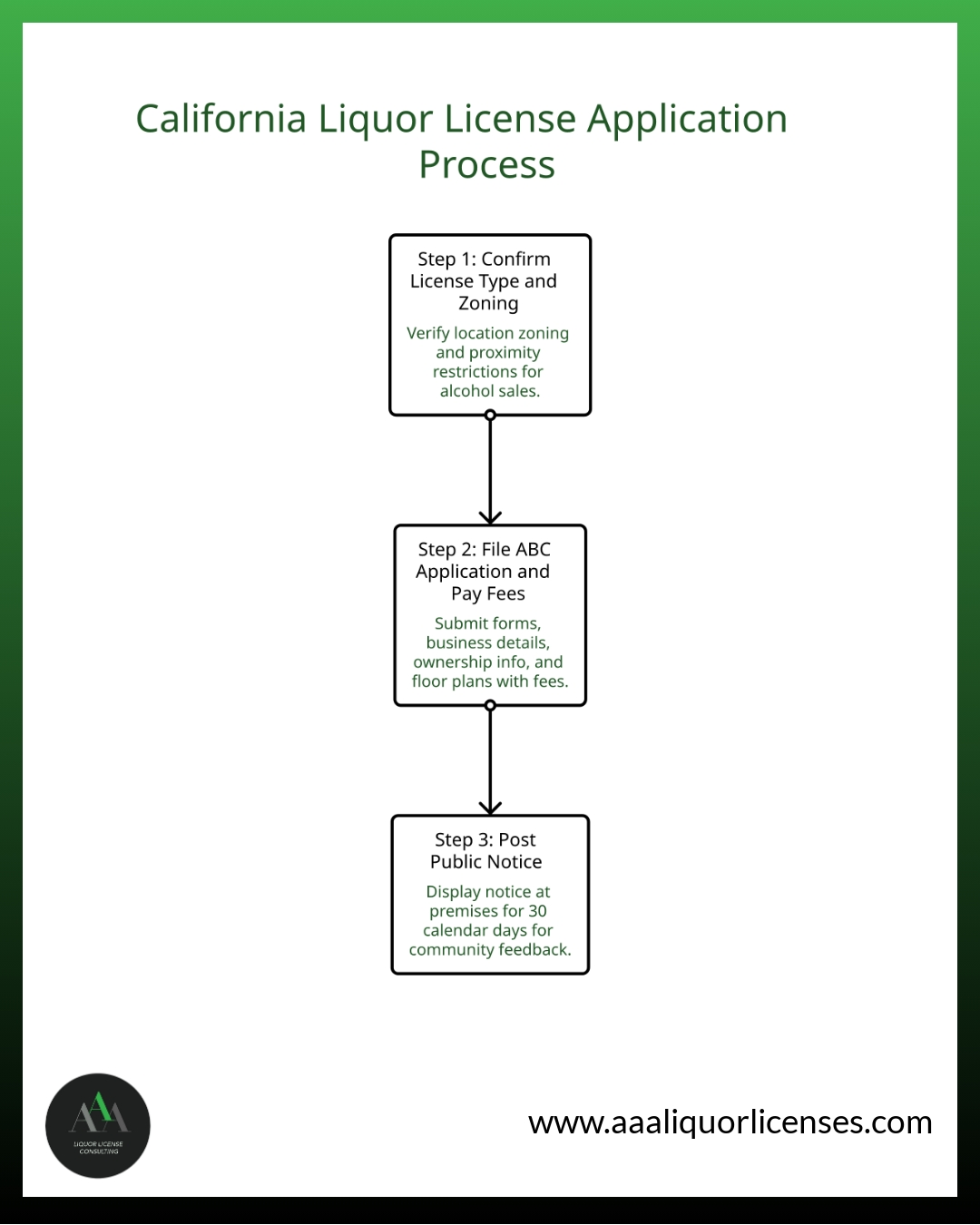
Step 1: Confirm Your License Type and Zoning
Before filing anything, confirm your location is zoned for alcohol sales and isn’t restricted by proximity to a school, church, or similar use. Skipping this step is one of the most common (and costly) mistakes first-time applicants make.
Step 2: File Your ABC Application and Pay Fees
You’ll submit the appropriate ABC form along with your business details, ownership information, financial statements, and floor plans. Application fees vary by license type and are published on ABC’s official fee schedule, so confirm current rates before budgeting.
Step 3: Post Public Notice
Once your application is filed, you’re required to post a public notice at the premises for 30 calendar days. This gives neighbors, community members, and local agencies a window to raise objections or offer support before your application moves forward.
Do You Need a Conditional Use Permit?
Often, yes. Many California cities and counties require a Conditional Use Permit (CUP) for alcohol sales at a given location, on top of the state ABC license itself. This is a separate local government process with its own hearing and timeline.
Do I need a seller’s permit to sell alcohol in California?
Yes. In addition to your ABC license, you need a seller’s permit from the California Department of Tax and Fee Administration, which is free to obtain.
What Happens During the Background Check and Premises Inspection?
ABC reviews your criminal history, financial stability, and past business dealings before issuing any license. Minor infractions rarely disqualify an applicant, but serious offenses, especially anything alcohol- or violence-related, can lead to denial.
Once the background check is complete, ABC inspects the physical premises, checking things like signage, storage areas, fire safety, and whether the space actually matches what was approved through local zoning and any required CUP.
If all of this sounds like a lot to track while you’re also trying to open a business, that’s normal.
AAA Liquor License Consulting has spent over 40 years managing exactly this process for California business owners, from the initial ABC form to CUP coordination.
Can You Sell Alcohol While Your Application Is Pending?
Sometimes, yes. If you’re buying an existing license through a transfer, ABC can issue a temporary permit good for 120 days, letting you operate while the transfer paperwork finishes processing, as long as the premises had recently been operating under a license. If your original application gets protested, you may be able to request an Interim Retail Permit instead, which also runs in 120-day increments, provided ABC has already recommended approval before the protest hearing.
Neither of these is automatic. Both are issued at ABC’s discretion, so they’re worth asking about early rather than assuming one will be available.
What If Your Application Gets Denied?
You have the right to appeal. Denials, suspensions, and other adverse ABC decisions can be challenged before the Alcoholic Beverage Control Appeals Board, a separate body that reviews ABC’s decisions. You typically have 40 days from the date of the department’s decision to file a Notice of Appeal, though that window shrinks to 10 days for decisions marked “effective immediately.”
The Board reviews the existing record rather than hearing new evidence, so the strength of your original application matters more than anything you might want to add later.
If your application was withdrawn because of a protest, keep in mind you generally can’t refile at the same location for a year, which makes getting it right the first time worth the extra care.
What are common mistakes to avoid when applying for a liquor license?
The most common ones are applying before checking zoning or a needed CUP, submitting incomplete or inconsistent paperwork, underestimating the timeline against a lease start date, and skipping RBS certification for staff once the license is active. Any of these can delay approval or trigger a compliance issue later.
RBS Certification: The Step Business Owners Forget
Getting the license is only half the job. Since July 1, 2022, California has required every server, bartender, and manager at an on-premises licensed business to hold valid Responsible Beverage Service (RBS) certification.
New hires get 60 days from their start date to register, train, and pass the exam. Skip it, and your business, not just the employee, is the one that faces an ABC penalty.
Liquor License California: What You’ll Really Pay
Most guides quote a single application fee and leave it there. A realistic budget for a liquor license in California has several layers stacked on top of each other:
ABC application fee: Varies significantly by license type. General licenses like Types 47 and 48 carry the highest priority application fees, currently listed at $19,840 on ABC’s fee schedule, while non-general licenses like the Type 41 or Type 20 cost considerably less. Confirm current rates before budgeting, since fee schedules change periodically.
Annual renewal fees: Charged every year on top of the initial fee, scaled to your city’s population. Our renewal guide covers what to expect.
Local CUP fees: Vary widely by city and county, and can add a meaningful cost on top of the state fees if your location requires one.
Seller’s permit: A seller’s permit from the California Department of Tax and Fee Administration is required alongside your ABC license and is free to obtain, though it’s a step people sometimes forget to budget time for.
RBS training costs: A modest per-employee cost through an ABC-accredited provider, required for every alcohol-serving staff member.
Secondary market or broker costs: If you’re buying an existing license instead of applying fresh, expect a purchase price that varies widely by county, plus any broker fee if you use one.
Let AAA Liquor License Consulting Make Your California Liquor License Process Simple
No two liquor license applications look the same. Some businesses sail through in 90 days. Others hit a quota wall, a protest, or a CUP hearing they didn’t see coming. The official checklist is the same for everyone, but the path through it rarely is.
That’s the part a search engine can’t tell you, and it’s exactly where 40+ years of doing this for California business owners comes in. AAA Liquor License Consulting has handled new applications, secondary market purchases, and CUP coordination in counties across the state, including the ones where a general license hasn’t opened up in years.
Contact us today if you want someone who’s already seen your specific situation play out before.


